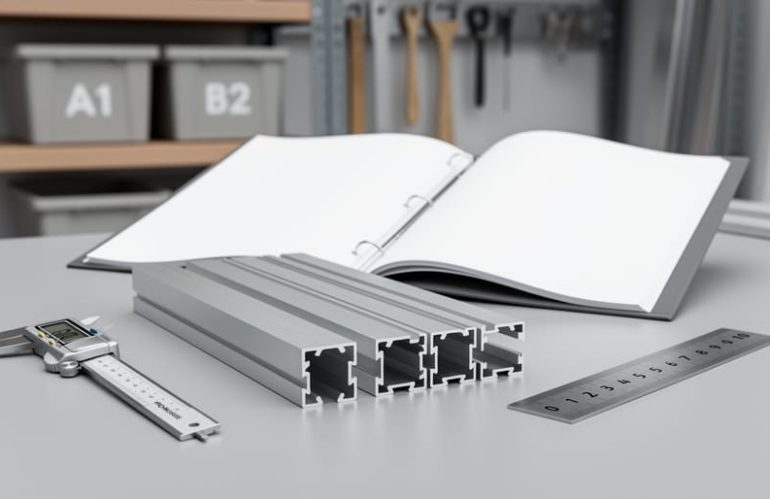
Navigating an aluminum profile catalog effectively means understanding how manufacturers organize their offerings and knowing when to select from standard inventory versus requesting custom extrusions. For most construction and architectural applications, this decision hinges on three factors: project timeline, volume requirements, and dimensional tolerances. Standard profiles, typically available in established series like 80/20’s 10 and 15 series with stock lengths of 97, 145, and 242 inches, offer immediate availability and predictable pricing. Custom profiles deliver precise geometries for specialized applications but require longer lead times and minimum order quantities.
The aluminum profile industry has evolved considerably to serve diverse sectors, from building facades and fenestration systems to industrial framing and furniture components. Major suppliers like BOR-USA maintain extensive portfolios spanning standard profiles alongside specialized families for windows, facades, balconies, lighting, cooling, and furniture applications. PROFALL segments their catalog into three distinct categories: standard, special, and completely customized profiles, each addressing different specification requirements and procurement constraints.
Modern catalogs increasingly provide digital tools that streamline selection and ordering. TSLOTS offers a comprehensive CAD library with downloadable extrusions and components, plus web-based design and pricing software that allows architects and engineers to configure solutions before placing orders. This digital infrastructure reduces specification errors and accelerates project timelines, particularly valuable when coordinating complex curtain wall or structural framing systems.
Successful catalog navigation requires balancing technical requirements against practical constraints like budget, delivery schedules, and sustainability considerations. Understanding catalog organization, profile classification systems, and the trade-offs between standardized and custom solutions positions procurement specialists and design professionals to make informed decisions that optimize both project performance and cost efficiency.
Understanding Aluminum Profile Catalogs: Standard vs. Customized Options
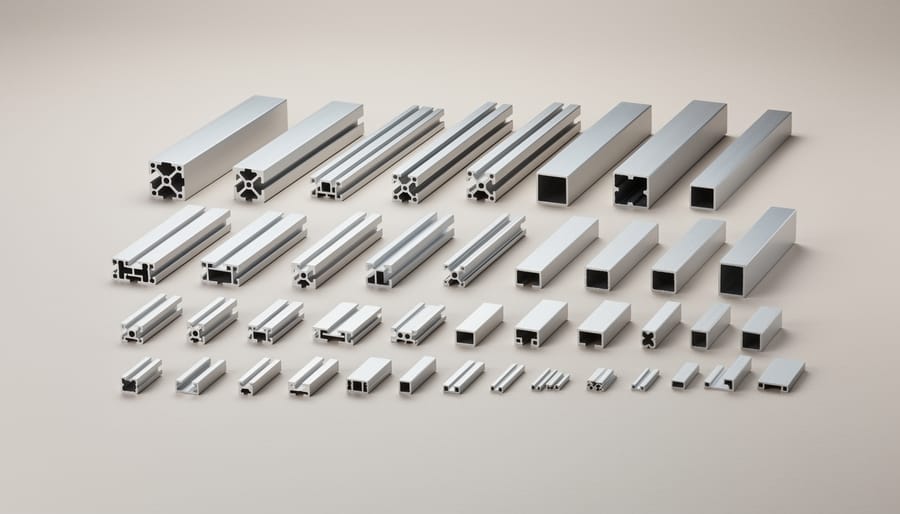
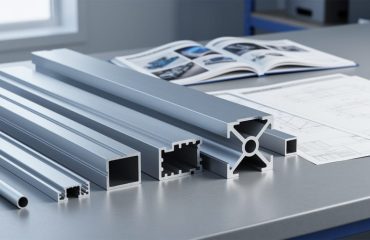
Aluminum profile catalogs function as comprehensive technical libraries that organize hundreds or thousands of extrusion options into searchable product families. These catalogs group profiles by application type, windows, facades, structural systems, balconies, lighting, cooling, furniture, and industrial uses, making it easier to locate profiles matched to your project requirements. Understanding how catalogs structure this information determines how efficiently you can specify the right profiles and avoid costly selection errors.
The fundamental distinction in any aluminum profile catalog separates standard profiles from customized options. Standard profiles are off-the-shelf extrusions manufactured in volume and held in inventory, offering immediate availability and predictable pricing. Major suppliers like 80/20 currently offer 57 profiles across their fractional unit lines, organized into standard series such as the 10 series and 15 series that share compatible dimensions and accessories. These stock profiles come in predetermined lengths, typically 97 inches, 145 inches, and 242 inches, designed to accommodate common project scales while minimizing waste.
Specialized profile families occupy the middle ground between standard and fully custom options. These include purpose-built extrusions for specific applications: window systems with integrated drainage channels, facade profiles engineered for glazing retention, balcony railings meeting safety codes, lighting track systems, cooling fin assemblies, and furniture framework. While specialized profiles follow standardized designs, they offer more application-specific features than basic structural shapes.
Completely customized aluminum profiles represent bespoke extrusions designed to your exact specifications. Custom profiles require engineering drawings, tooling investment, and minimum order quantities, but they deliver precise dimensional control, proprietary cross-sections, and optimized performance that standard options cannot match. The decision between standard and custom hinges on project volume, timeline flexibility, budget constraints, and whether existing catalog options meet your structural and aesthetic requirements.
Modern catalogs provide navigation tools beyond static product lists. Downloadable CAD libraries include precise 3D models of each profile, allowing direct integration into design software. Web-based design tools let you configure assemblies, verify dimensional compatibility, and generate instant pricing before placing orders. Pre-configured solutions bundle commonly specified profile combinations with matching accessories, streamlining procurement for standard applications while ensuring component compatibility across the system.
Types of Aluminum Profiles: Comparing Your Options
Standard Aluminum Profiles
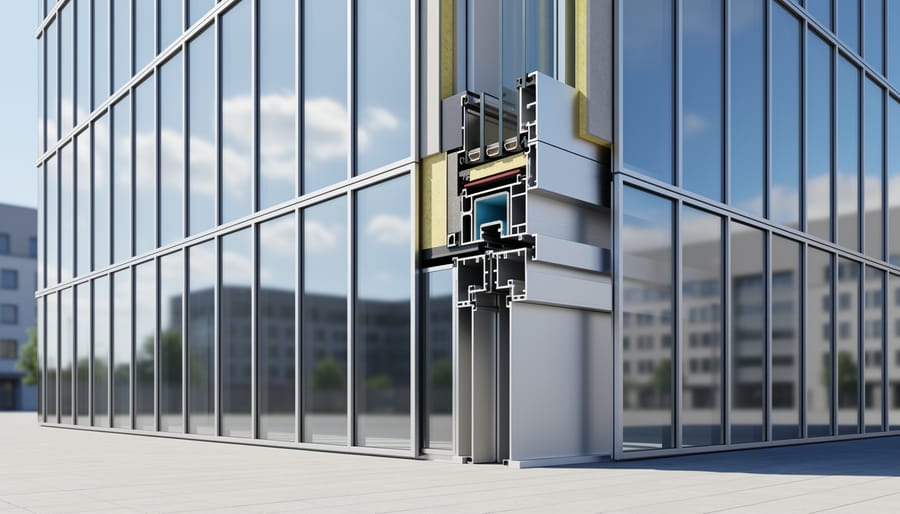
Standard aluminum profiles represent the readily available, off-the-shelf options that manufacturers keep in continuous production. These profiles follow established dimensions and specifications, making them the go-to choice for projects requiring quick turnaround and proven performance.
T-slot framing systems dominate the industrial and structural categories. Suppliers like 80/20 currently offer 57 profiles in fractional units, organized into standardized series. The 10 series features smaller cross-sections suited for lightweight applications, think workstations, enclosures, and display fixtures. The 15 series scales up for heavier-duty structural demands, including machine frames and conveyor systems. These profiles share a fundamental advantage: interchangeable components across the series, which simplifies assembly and future modifications.
Stock lengths typically run 97 inches, 145 inches, and 242 inches, though availability varies by supplier. These predetermined lengths reduce manufacturing costs but require careful planning to minimize waste during cutting and fabrication.
Architectural profiles form another major standard category. Window and facade systems appear in catalogs as complete families, matching frame profiles, sash sections, and glazing beads designed to work together. These standardized systems have undergone extensive testing for water infiltration, air leakage, and structural performance, delivering predictable results that meet building codes without custom engineering.
The primary advantage of standard profiles is immediate availability. Most suppliers maintain inventory for rapid shipment, often within days rather than the weeks or months custom extrusions demand. You also gain access to established accessory ecosystems, fasteners, connectors, end caps, and brackets designed specifically for each profile series. This compatibility eliminates the guesswork and potential delays of sourcing compatible hardware for custom designs.
Special-Purpose Profile Families
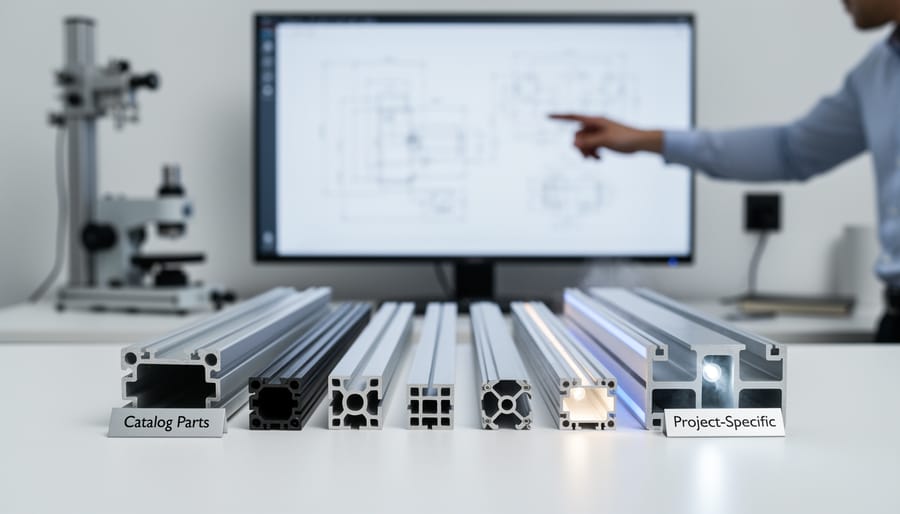
Between standard off-the-shelf profiles and fully customized extrusions lies a middle ground of specialized profile families engineered for specific applications. These purpose-built categories address recurring industry needs while offering more focused solutions than general-purpose structural systems.
Lighting system profiles incorporate integrated channels for LED strips, diffuser grooves, and mounting mechanisms designed specifically for commercial and architectural illumination. These profiles eliminate the need to retrofit standard extrusions for lighting applications, providing factory-engineered solutions that ensure proper thermal management for LED components and consistent light distribution.
Cooling and thermal management profiles feature enhanced fin designs, optimized cross-sections for airflow, and mounting geometries tailored to heat sinks and HVAC applications. Their specialized geometry maximizes surface area and thermal conductivity, making them distinct from structural profiles that might superficially appear similar.
Balcony and railing systems represent another specialized category, with profiles incorporating specific drainage channels, weather seals, and glass retention features required by building codes. These families include coordinated post, rail, and infill components designed to work as complete systems rather than assembled from generic extrusions.
Furniture and display profiles serve commercial interiors, retail environments, and modular workstations with specialized corner connectors, cable management channels, and aesthetic finishes that standard industrial profiles lack. These bridge the gap between construction-grade and fully custom furniture extrusions.
Specialized profile families offer shorter lead times than completely customized options while providing application-specific features that standard structural profiles cannot match. They represent catalog efficiency applied to recurring specialized needs across industries.
Completely Customized Aluminum Profiles
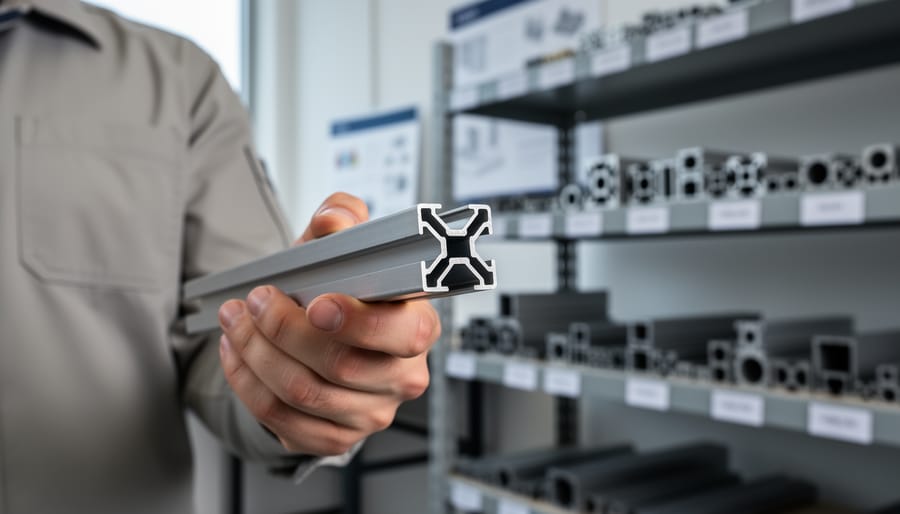
Completely customized aluminum profiles represent the ultimate in design flexibility, allowing you to specify every dimension, wall thickness, internal chamber, and feature to match exact project requirements. Unlike standard or special-purpose profiles, custom extrusions start from your technical drawings, whether that’s a hand sketch, CAD file, or detailed cross-sectional specification, giving you complete control over the final geometry.
The design process begins with defining your profile’s functional requirements: load-bearing capacity, thermal performance, attachment points, and integration with other building components. From there, extrusion engineers evaluate manufacturability, recommend wall thickness optimization to balance strength and weight, and identify cost-effective modifications that maintain performance while improving production efficiency. Critical design parameters include minimum wall thickness (typically 1-2mm for aluminum extrusions), corner radii requirements, draft angles for smooth extrusion, and overall cross-sectional complexity that affects tooling costs.
Custom profiles require dedicated tooling, a steel die machined to your exact specifications, which represents the primary upfront investment. Minimum order quantities typically range from 500 to 1,000 linear meters depending on profile complexity, though some manufacturers accommodate smaller prototype runs. Lead times extend significantly beyond standard profiles: expect 4-6 weeks for die production, sample extrusion, and approval cycles before full production begins. The prototyping phase proves invaluable, allowing physical testing of dimensions, finish quality, and assembly compatibility before committing to large-scale manufacturing.
Custom extrusions justify their investment when standard profiles compromise structural integrity, create excessive material waste through modification, or fail to accommodate specialized fastening systems. Large-scale projects with repetitive applications, curtain wall systems spanning multiple buildings, proprietary equipment frames, or signature architectural elements, distribute tooling costs across sufficient volume to make customization economically viable. For projects demanding unique thermal breaks, integrated gasket channels, or non-standard mounting configurations, custom profiles often prove more cost-effective than field-modifying standard alternatives.
Key Factors When Selecting From an Aluminum Profile Catalog
Dimensional Requirements and Stock Lengths
Understanding profile dimensions and stock lengths determines both project feasibility and cost efficiency. Begin by reviewing the cross-sectional specifications that match your structural or architectural requirements. Profile catalogs organize dimensions by series, such as 10 series and 15 series systems, with each series offering specific slot widths, wall thicknesses, and moment of inertia values that dictate load-bearing capacity. Verify that the profile’s cross-section accommodates your fastener types, mounting hardware, and any thermal break requirements.
Stock length availability directly impacts material waste and fabrication costs. Many standard extrusion profiles are available in lengths such as 97 inches, 145 inches, and 242 inches. Calculate your required cutting lengths against available stock sizes to minimize scrap; ordering 145-inch stock when you need multiple 70-inch pieces wastes less than ordering 242-inch lengths. Custom lengths eliminate waste but typically carry minimum order quantities and extended lead times that can add four to eight weeks to your project schedule.
For large-scale projects, request the catalog’s optimization guidelines or consult with the supplier’s technical team to determine the most economical combination of stock lengths. Consider how dimensional tolerances, typically ±0.020 inches for standard profiles, affect assembly fit, especially in precision applications where tight clearances matter. Profile dimensions also determine compatibility with standard accessories and connectors, which avoids costly custom fabrication of mounting components.
Material Specifications and Performance Standards
Material specifications form the technical foundation of any aluminum profile selection, directly impacting structural performance, longevity, and project outcomes. Understanding these specifications ensures you match the profile’s capabilities to your application’s demands rather than discovering incompatibilities during installation.
Alloy grades represent the first critical specification. The 6000-series alloys, particularly 6063 and 6061, dominate architectural and structural applications because they combine excellent extrudability with strong corrosion resistance and moderate strength. 6063 suits most window frames, curtain walls, and decorative applications where surface finish quality matters. 6061 delivers higher strength for load-bearing structural members and industrial frames subjected to mechanical stress. Reputable catalogs specify the alloy composition clearly, allowing engineers to verify compatibility with project load calculations and environmental conditions.
Temper designations indicate the heat treatment and work hardening applied after extrusion, fundamentally altering mechanical properties. T5 and T6 tempers appear most frequently in catalogs. T6-tempered profiles offer maximum strength through solution heat treatment and artificial aging, making them essential for structural applications. T5 tempers provide moderate strength with better formability for components requiring post-fabrication bending or machining. The catalog should state temper clearly alongside tensile strength, yield strength, and hardness values that your structural engineer needs for compliance verification.
Surface finish options extend beyond aesthetics to corrosion protection and thermal performance. Anodizing, powder coating, and mechanical finishes each deliver different durability profiles, maintenance requirements, and thermal characteristics. ISO 9001 certification and adherence to relevant ASTM or EN standards signal a manufacturer’s commitment to consistent quality across these specifications, confirmation that catalog claims match delivered performance.
Availability and Lead Time Considerations
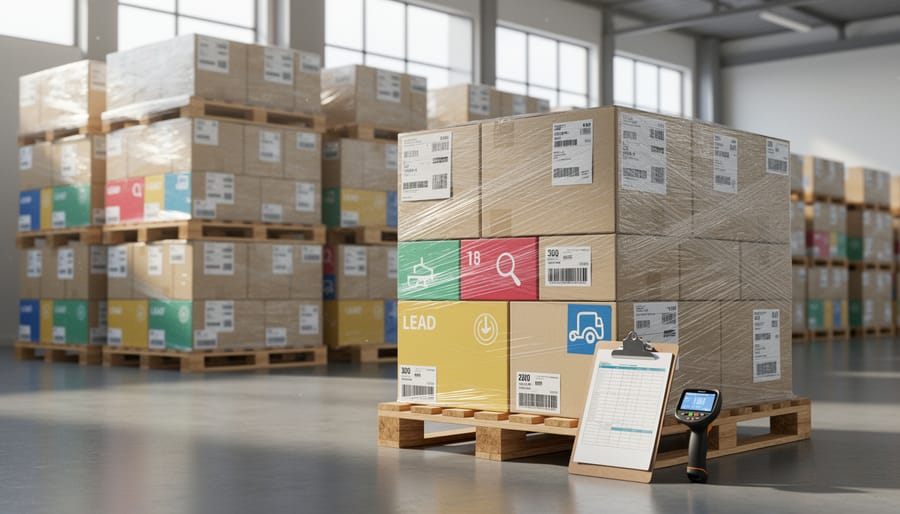
Stock availability varies dramatically between standard and custom aluminum profiles, directly impacting project schedules. Standard profiles from established manufacturers typically ship within days to two weeks when catalog items are in stock, 80/20 maintains inventory in stock lengths of 97, 145, and 242 inches for immediate fulfillment. Custom extrusions require tooling fabrication and production scheduling, extending lead times to 6-12 weeks minimum, sometimes longer for complex geometries or high-volume orders.
Modern catalog resources streamline the specification process regardless of profile type. CAD libraries provide downloadable files for all standard extrusions and components, eliminating manual drawing time. Web-based design and pricing software enables real-time configuration of assemblies with instant cost feedback, while pre-configured solutions offer tested starting points for common applications. These digital tools reduce design iteration cycles and ordering errors.
When evaluating catalog options, verify actual inventory status rather than assuming availability. Request specific lead time confirmation for your required quantities and lengths, particularly for architectural projects with fixed installation windows. Standard profiles offer scheduling certainty, but custom solutions may justify extended timelines when performance requirements cannot be met with off-the-shelf alternatives. Build appropriate buffer time into procurement schedules based on profile type selection.
Accessory Compatibility and System Integration
Successful system integration depends on identifying compatible accessories before finalizing profile selection. Comprehensive catalogs include technical datasheets specifying which fasteners, connectors, brackets, and end caps work with each profile series, verify these specifications match your assembly requirements rather than assuming universal compatibility across manufacturers.
Check whether the catalog provides connection load ratings and assembly torque values, which prove essential for structural applications requiring verifying profile load strength. CAD libraries that include both profiles and accessories let you test fit-up digitally, catching interference issues during design rather than installation. Standard profiles typically offer extensive accessory ecosystems with immediate availability, while custom profiles may require custom-machined connection components that extend lead times and increase total system costs beyond the extrusion price alone.
Navigating Catalog Resources: CAD Libraries and Design Tools
Modern aluminum profile catalogs extend far beyond static PDFs. Manufacturers increasingly provide digital resources that transform specification and procurement from a manual process into an efficient, error-reducing workflow. Understanding how to leverage these tools saves time during design phases and reduces costly ordering mistakes.
The most valuable catalog resource is a comprehensive CAD library. Leading suppliers maintain downloadable 2D and 3D models for every profile in their range, allowing you to drop accurate geometries directly into your design software rather than redrawing from dimensional drawings. These libraries typically include common file formats such as DWG, DXF, STEP, and IGES to ensure compatibility across platforms. Before committing to a supplier, verify their CAD library covers the profiles you need and updates regularly to reflect current offerings.
Web-based design and pricing software represents another significant advancement. Several manufacturers now offer browser-based configurators where you can select profiles, specify lengths, choose finishes, add accessories, and receive instant pricing. These tools often include pre-configured solutions for common applications like workbenches, machine guards, and conveyor supports, which you can customize rather than designing from scratch. The software generates cut lists, assembly instructions, and purchase orders, streamlining the entire procurement cycle.
Essential catalog resources to maximize include:
- Downloadable CAD files in multiple formats for direct integration with design software
- Interactive design tools with real-time pricing and configuration capabilities
- Comprehensive technical datasheets with material specifications and tolerances
- Load capacity tables showing moment of inertia and section modulus for structural applications
- Finish option guides detailing anodizing, powder coating, and other surface treatments
- Installation manuals and assembly guides for complex profile systems
Pay particular attention to technical specification guides that detail tolerances, material grades, and performance characteristics. These documents prove essential when coordinating with engineers and quality control specialists who must verify that selected profiles meet project requirements. Request access to technical support contacts who can clarify specification questions that documentation doesn’t fully address.
When to Choose Standard vs. Customized Aluminum Profiles
Making the right choice between standard and customized aluminum profiles requires balancing project requirements against practical constraints. Standard profiles excel when you need proven dimensions that align with widely available accessories, fast procurement, and predictable pricing. They work particularly well for projects with tight deadlines, limited budgets, or applications where industry-standard dimensions already match your structural and aesthetic needs. Architects specifying window systems or industrial designers building modular frames typically find standard catalogs sufficient, especially when leveraging a CAD-ready PDF reference to verify compatibility with existing designs.
Choose standard profiles when your project timeline allows minimal lead time (typically days to weeks rather than months), when you’re working with established system integrations that require common T-slot dimensions or structural series specifications, or when order quantities don’t justify tooling investment. Standard options also make sense for prototyping and testing phases before committing to large-scale custom production.
Customized profiles become essential when standard catalog dimensions create excessive material waste, when unique cross-sectional geometries deliver measurable performance advantages, or when proprietary designs differentiate your product in the marketplace. Facade systems with specific thermal break requirements, lighting fixtures requiring integrated cable channels, or industrial equipment demanding precise load distribution often justify custom tooling costs. The break-even point typically arrives when order volumes exceed several thousand linear feet and when design optimization reduces assembly complexity or material usage enough to offset higher initial investment.
Select custom extrusions for projects where standard profiles force costly secondary operations like drilling, cutting, or welding that custom geometry eliminates, when aesthetic differentiation matters competitively, or when consolidating multiple components into a single extrusion reduces assembly labor. Construction managers should factor in 8-12 week lead times for tooling and first-run production, plus prototype testing phases that standard profiles bypass entirely.
Projects with moderate complexity sometimes benefit from special-purpose profile families that bridge these extremes, pre-engineered systems for balconies, cooling, or furniture applications that offer customization within standardized frameworks. These deliver faster lead times than fully custom extrusions while accommodating specific application requirements that generic T-slot systems cannot address.
Common Mistakes to Avoid When Ordering From Aluminum Profile Catalogs
Ordering errors can derail timelines, inflate budgets, and compromise structural integrity. These preventable mistakes occur when buyers rush through catalog selection without verifying critical specifications or understanding the full scope of profile procurement.
The most damaging errors stem from misaligned expectations about availability and customization. Many buyers assume catalog listings guarantee immediate shipment, but standard profiles may still require lead times of several weeks during peak construction seasons, while custom extrusions typically demand 6-12 weeks from design approval to delivery. Underestimating these timelines forces costly project delays or expensive expedited manufacturing fees that can double unit costs.
Specification oversights create equally serious problems. Ignoring minimum order quantities for custom profiles, often 500-1000 linear feet, leaves small-scale projects paying premium tooling costs that eliminate any performance advantage over adapted standard solutions. Similarly, buyers who select profiles based solely on cross-sectional dimensions without verifying load ratings risk structural failures, particularly in facade and metal roofing types where profiles must withstand wind loads and thermal expansion cycles.
Common procurement mistakes include:
- Assuming all catalog profiles ship immediately without confirming actual inventory status
- Ignoring minimum order quantities that make custom profiles cost-prohibitive for smaller projects
- Selecting profiles without verifying compatible fasteners, connectors, and accessories are readily available
- Overlooking thermal break requirements and U-value specifications for energy-efficient applications
- Neglecting to confirm ISO certification and quality standards documentation from the manufacturer
Finish compatibility errors cause visible defects that require expensive rework. Mixing anodized profiles with powder-coated accessories creates jarring color mismatches, while combining different alloy grades can trigger galvanic corrosion in coastal or industrial environments. Always specify complete systems, profiles, connectors, and finishes, from compatible product families within the same catalog series.
The costliest mistake involves focusing exclusively on profile unit pricing while ignoring total system costs. A seemingly economical standard profile may require extensive custom fabrication, specialized connectors, or additional structural support that pushes installed costs above a purpose-designed custom extrusion. Calculate complete assembly costs including cutting, drilling, fasteners, labor, and waste factors before finalizing your selection. Request detailed quotations that break down all components rather than accepting isolated profile prices that hide the true project investment.
Main Options Compared
When evaluating aluminum profile catalogs, buyers face three primary options, each suited to different project requirements and constraints.
Standard Catalog Profiles represent the most accessible choice, offering immediate availability from established series like the 10 series and 15 series systems. These profiles come in fixed cross-sections with stock lengths typically available in 97 inches, 145 inches, and 242 inches. The advantages include predictable pricing, no minimum order quantities, and extensive accessory ecosystems with compatible fasteners and connectors. Standard profiles work well for modular construction, equipment frames, and applications where dimensional flexibility isn’t critical. They’re particularly effective for projects with tight timelines or when testing concepts before committing to custom tooling.
Special-Purpose Profile Families occupy the middle ground, providing pre-engineered solutions for specific applications such as window systems, facades, balconies, lighting installations, and solar panel installation mounting. These profiles balance customization with availability, offering application-optimized geometries without requiring full custom extrusion. Many manufacturers maintain CAD libraries with downloadable files and web-based design tools for these families.
Completely Customized Profiles deliver exact specifications for unique structural requirements, complex geometries, or proprietary designs. While requiring longer lead times and minimum order commitments, custom extrusions eliminate compromises in performance, aesthetics, or integration.
Frequently Asked Questions About Aluminum Profile Catalogs
Understanding the intricacies of aluminum profile catalogs often raises specific questions during the selection and procurement process. These frequently asked questions address common concerns that architects, engineers, and procurement specialists encounter when navigating catalog resources and making specification decisions.
What’s the difference between a 10 series and 15 series profile?
The series designation refers to the profile’s nominal dimension in fractions of an inch. A 10 series profile has a 1-inch nominal face dimension, while a 15 series has a 1.5-inch nominal face dimension. The larger 15 series profiles provide greater structural strength and load capacity for applications requiring more robust support.
How long does custom profile development take?
Custom aluminum profile development typically requires 6-12 weeks from design approval through first production runs, depending on complexity and tooling requirements. This timeline includes die manufacturing, sample extrusion runs, quality verification, and final approval before full production begins.
Can I order small quantities of standard profiles?
Most manufacturers accommodate small-quantity orders of standard catalog profiles without minimum order requirements, though unit pricing may be higher than bulk purchases. Standard profiles in common series are typically available in stock lengths for immediate shipment, making them practical for prototypes, repairs, or small projects.
What file formats are CAD libraries provided in?
Modern catalog CAD libraries typically provide files in multiple formats including STEP, IGES, DXF, and DWG to ensure compatibility with various design software platforms. Many manufacturers also offer native files for popular CAD systems like SolidWorks, AutoCAD, and Inventor, along with web-based design tools that don’t require file downloads.
How do I verify a manufacturer’s quality certifications?
Request current copies of ISO 9001 quality management and ISO 14001 environmental certifications directly from the manufacturer, and verify the certification body and expiration dates. Reputable manufacturers make their certifications readily available through their websites or technical documentation, and third-party verification through certification registries confirms authenticity.
Beyond these core questions, many buyers wonder about technical support availability during the specification process. Established aluminum profile manufacturers typically provide engineering assistance to help interpret catalog specifications, validate design choices, and recommend appropriate accessories for complete system integration. This support proves particularly valuable when transitioning from preliminary catalog selection to detailed project specifications.
The ordering process itself varies by manufacturer but generally follows a consistent pattern. After selecting profiles from the catalog, you’ll typically need to specify exact lengths, finish requirements, and any secondary operations such as drilling, tapping, or cutting. Many catalogs now integrate with web-based pricing tools that generate instant quotes based on these specifications, streamlining what was once a manual back-and-forth process.
For projects requiring custom profiles, expect more extensive documentation requirements. Manufacturers need detailed cross-section drawings, tolerance specifications, alloy preferences, and finish requirements before providing accurate quotes. The investment in custom tooling means most manufacturers establish minimum order quantities for fully customized profiles, though these thresholds have decreased as extrusion technology has advanced.
Technical documentation accompanying catalog profiles has evolved significantly. Beyond basic dimensional drawings, comprehensive catalogs now provide load tables, thermal performance data, deflection calculations, and installation guidelines. Understanding how to access and interpret these resources ensures you’re making informed decisions based on complete technical information rather than just profile geometry.
Understanding aluminum profile catalogs empowers you to make faster, more cost-effective decisions for your construction and industrial projects. Whether you’re specifying standard profiles for quick deployment or developing custom extrusions for specialized applications, knowing how to navigate catalog structures, evaluate technical specifications, and balance performance requirements against project constraints positions you for successful outcomes.
Standard profiles deliver immediate availability and proven compatibility, making them ideal for projects with tight timelines or budget constraints. Customized solutions provide the design flexibility needed for unique architectural visions, specialized performance requirements, or competitive differentiation. The strategic value lies in recognizing when each approach serves your project best, and how to leverage both within a single specification when circumstances demand it.
Long Metal Solar Roofing brings over twenty years of aluminum manufacturing expertise to both standard and customized profile solutions. Our ISO-certified production facilities maintain rigorous quality standards across every extrusion run, ensuring consistent dimensional accuracy and material performance whether you’re ordering catalog items or developing entirely new profiles. We support architects and specifiers from initial design consultation through final delivery, providing CAD libraries, technical documentation, and engineering support that streamline your specification process.
Our commitment extends beyond manufacturing excellence to environmental responsibility. Sustainability drives our material sourcing, production efficiency, and recycling initiatives, aligning with the green building standards your projects increasingly require. From first inquiry to project completion, we deliver the technical expertise, customization capabilities, and client-focused service that turn profile specifications into built reality.